
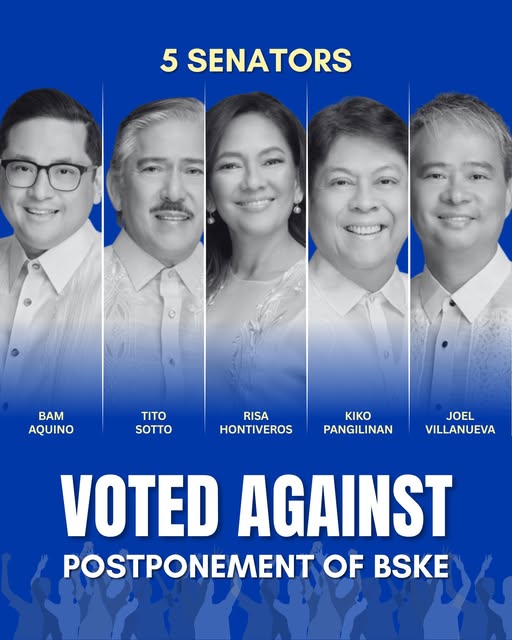
Editorial Disclaimer: This civic analysis and legislative policy critique examines the Senate’s second-reading approval of Senate Bill No. 2387, which seeks to extend the term of Barangay and Sangguniang Kabataan (BSKE) officials to five years, effectively deferring the scheduled November 2026 elections. This piece contrasts the rationale of the majority who voted in favor with the arguments of the five dissenting lawmakers—Senators Bam Aquino, Risa Hontiveros, Tito Sotto, Kiko Pangilinan, and Joel Villanueva.
The debate over the frequency of grassroots elections has once again reached the Senate floor.
With only five senators—Bam Aquino, Risa Hontiveros, Tito Sotto, Kiko Pangilinan, and Joel Villanueva—voting against the passage on second reading of Senate Bill No. 2387, the upper chamber pushed closer toward fixing the terms of barangay and SK officials at five years.
If enacted, the measure would postpone the scheduled November 2026 Barangay and Sangguniang Kabataan Elections (BSKE).
While critics argue that postponing elections robs citizens of their constitutional right to change local leaders, the majority of the chamber rallied behind the bill for specific fiscal and administrative reasons.
1. Legislative Matrix: The Two Sides of the BSKE Debate
| Perspective | Majority Senators (In Favor of 5-Year Term) | The 5 Dissenting Senators (Against Postponement) |
| Continuity of Projects | 3 years is too short for long-term community programs, infrastructure, and peace & order initiatives. | Short terms ensure accountability; bad local officials should not stay entrenched without mandate renewal. |
| Election Fatigue & Partisanship | Frequent village polls cause chronic community division, family feuds, and politicized barangay halls. | Regular suffrage is the bedrock of democracy; election fatigue is the price of keeping power checked. |
| Fiscal Savings | Staging nationwide manual elections costs billions of pesos that could be diverted to public services. | The Supreme Court (Macalintal v. Comelec) already set strict guidelines against arbitrary poll deferments. |
| SK Transition & Maturity | Youth leaders spend the first year learning procurement; a longer term maximizes their training. | Extended terms in SK can cause members to age out beyond the legal youth bracket mid-term. |
2. Malalimang Pagsusuri: The Majority’s Core Rationale (Deep Dive)
-
1. The “Too Short for Real Governance” Argument:
-
Proponents emphasize that barangay officials function as the frontline bureaucracy—handling dispute resolutions (Katarungang Pambarangay), disaster risk management, feeding programs, and grassroots law enforcement.
-
In a three-year cycle, officials typically spend their first year adjusting to local government accounting and procurement rules, their second year executing projects, and their third year campaigning. Majority senators maintain that a five-year term provides administrative breathing room to execute meaningful multi-year development plans.
-
-
2. Relieving Fiscal and Operational Pressure:
-
Holding synchronized nationwide manual elections every three years requires substantial budgetary allocations—often exceeding ₱8 to ₱10 billion—alongside intense security deployment from the PNP and AFP.
-
Lawmakers backing the measure argue that aligning barangay stability helps the national government save logistical resources, especially given tightening fiscal ceilings across other frontline departments.
-
-
3. Healing Neighborhood Divisiveness:
-
Barangay politics is personal. Unlike national elections where candidates are distant figures, village races pit neighbors, relatives, and street associations against one another. Proponents note that frequent elections prolong factional friction, stalling basic community cooperation.
-
3. Tatlong Pagninilay sa Tungkulin at Halalan sa Komunidad
-
Balance Stability with Public Accountability: Long terms only work when mechanisms for transparency and recall are active. If officials are given five full years to govern, community assemblies and local audits must be strictly enforced.
-
Suffrage Is a Sacred Check on Power: The concerns raised by the dissenting senators highlight an enduring truth: regular elections remind public servants that power belongs to the sovereign people, not the seat.
-
Good Citizenship Transcends Election Day: True neighborhood progress does not depend solely on who sits in the barangay hall. Active participation in community cleanup, parish ministries, and civic watchfulness shapes local life far more than passive waiting for the next campaign.
The path of Senate Bill No. 2387 now moves to final deliberations and bicameral scrutiny. Whether terms are extended or kept at three years, the core demand remains identical: grassroots leaders who serve with genuine integrity, humbleness, and competence.
Do you support extending barangay and SK terms to five years to allow for project continuity, or should elections proceed on schedule every three years to keep officials accountable? Share your civic perspective in the comments below!