
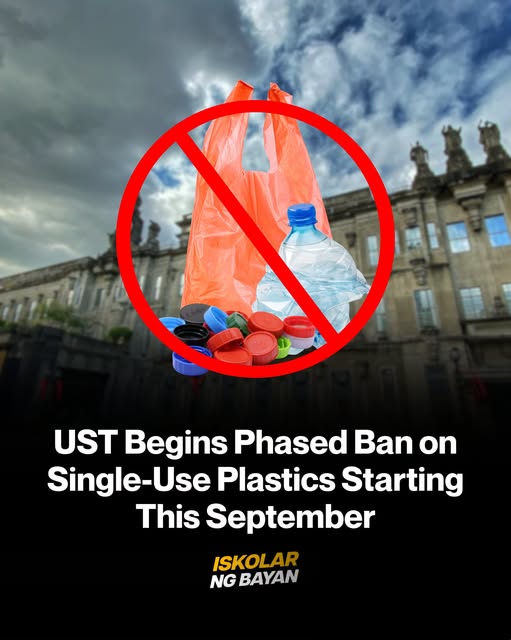
Editorial Disclaimer: This institutional policy review, environmental stewardship commentary, and lifestyle analysis examines University of Santo Tomas Memorandum UST:SO06-00-ME05 (A.Y. 2026–2027) issued by the Office of the Secretary-General on September 2, 2026. Rooted in Catholic social teaching and Pope Francis’ encyclical Laudato Si’, this piece evaluates the “concessionaires-first” phased ban on single-use plastics, the transition hurdles facing campus stakeholders, and what genuine ecological conversion demands from student culture.
Institutions often speak about ecological responsibility in lofty, abstract slogans. It is far harder to enforce environmental stewardship when it disrupts the daily mechanics of takeout lunches, paper-cup milk teas, and plastic cutlery.
The University of Santo Tomas (UST) officially initiated that shift through Memorandum UST:SO06-00-ME05, signed by Secretary-General Rev. Fr. Louie R. Coronel, OP on September 2, 2026.
Commencing this September 2026, the Pontifical University began the progressive rollout of an institutional ban on the use and distribution of single-use plastics across campus operations, special events, and student activities.
Grounding the policy in Pope Francis’ encyclical Laudato Si’ (Care for Our Common Home), the Global Compact on Education (GCE 7), and the UN Sustainable Development Goals (SDG 12: Responsible Consumption and Production), UST is putting theology into practice where it matters most: the daily waste bins along España Boulevard.
1. Policy Matrix: UST’s Single-Use Plastic Ban at a Glance
| Policy Dimension | Institutional Scope & Mandate (AY 2026–2027) |
| Initial Phase Focus | “Concessionaires-First” Approach: On-campus vendors, canteens, and food kiosks must discontinue single-use plastic distribution during Term 1. |
| Prohibited Materials | Plastic cups, straws, stirrers, utensils, plates, food containers, sachets, plastic carrier bags, and plastic wrapping/packaging. |
| Organizational Coverage | Academic units, administrative offices, accredited suppliers, event partners, and recognized student organizations. |
| Allowable Exceptions | Strict, justified exemptions limited to health, safety, laboratory work, accessibility, or specific regulatory needs. |
| Pilot-Testing Units | Selected Academic Units (AUs) testing protocols, while units with existing bans (such as UST JHS since 2019) strengthen local enforcement. |
2. Malalimang Pagsusuri: The Move from Convenience to Ecological Conversion (Deep Dive)
-
1. Why the “Concessionaires-First” Strategy Works:
-
Blanket bans implemented overnight often collapse because students and staff are caught without viable alternatives, leading to pushback or covert non-compliance.
-
By targeting campus food vendors first, UST cuts plastic waste at its primary source. Food stalls generate the highest volume of disposable packaging every lunch hour. Forcing commercial concessionaires to supply biodegradable containers, paper wraps, or incentivized reusable systems creates an environment where students naturally adopt reusable containers.
-
-
2. Theological Grounding: Laudato Si’ as Living Action:
-
In Laudato Si’, Pope Francis cautioned against the modern “throwaway culture” (cultura del descarte), where human beings treat creation as disposable matter designed for short-lived convenience.
-
For a Catholic university, environmental policy is not a secular public relations exercise; it is an extension of moral formation. Cleaning up campus waste acknowledges that caring for the physical environment directly impacts human dignity, urban flood vulnerability in Manila, and communal well-being.
-
-
3. Practical Adjustments for Thomasian Student Life:
-
Real sustainability requires behavioral change. Thomasians will need to plan their bags intentionally: carrying insulated tumblers, reusable cutlery pouches, and canvas tote bags alongside laptops and lecture binders.
-
The challenge shifts to the university and concessionaires to provide adequate, hygienic wash stations across buildings so students can wash and store reusable food containers between lectures without hygiene concerns.
-
3. Tatlong Pagninilay sa Makakalikasang Pamumuhay
-
Trade Convenience for Stewardship: Throwaway plastics feel easy because their real cost is deferred to urban drainage systems, rivers, and future generations. Choosing to carry your own utensils or tumbler is a quiet, daily sacrifice for the common good.
-
Support Businesses Making the Transition: Environmentally friendly packaging often costs concessionaires more. Rather than complaining about altered packaging or slight adjustments, support local vendors making the effort to phase out disposables.
-
Practice Ecological Discipline Everywhere: Do not let sustainable habits stop at the campus gates. The lessons learned under university policies should follow you into your parish, your workplace, and your home kitchen.
Caring for our common home begins with small, deliberate decisions. UST’s phased single-use plastic ban proves that lasting institutional change does not happen all at once—it is built step by step, meal by meal, and choice by choice.
Are you in favor of universities implementing mandatory bans on single-use plastics, or do you worry about added costs for food stalls and students? What reusable items have become non-negotiable staples in your daily everyday carry? Share your insights in the comments below!